
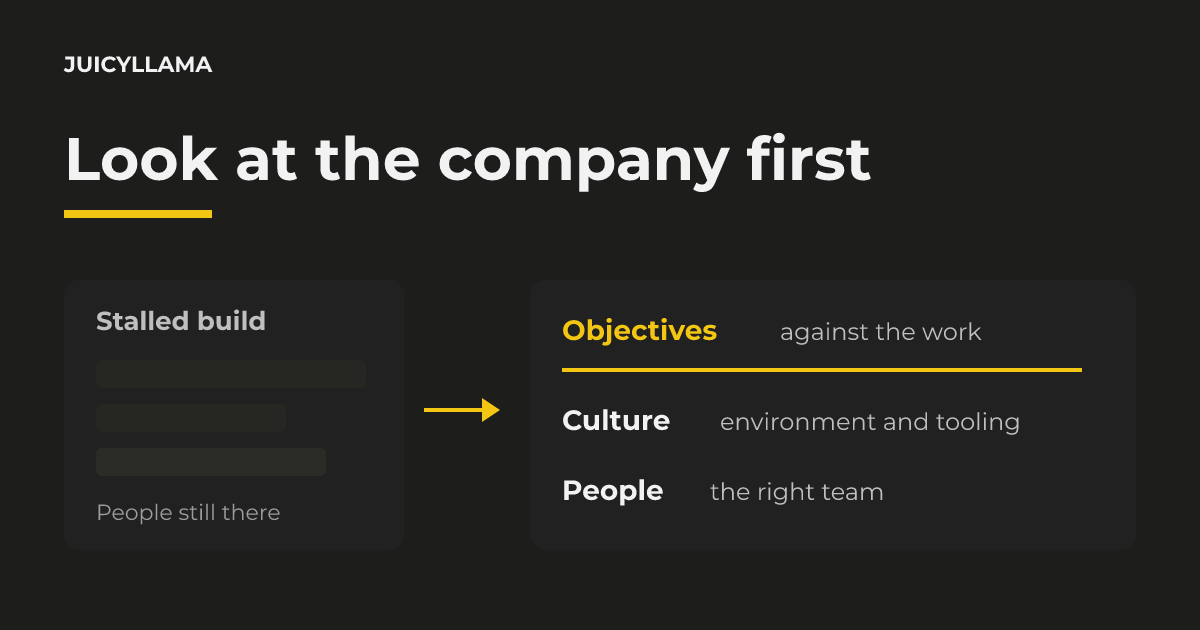
Your software build is stalled, late or failing, and the people who built it are still there. You are deciding whether to bring someone in to stabilise it, or to start again. This page is about that decision: a product you already depend on, and a point at which we may say no.
We do not offer software project rescue as its own service. A stalled build is treated as an existing system. We assess it, and if it fits we take it on under the fractional CTO service. If it does not fit, we say so and decline, or we offer a tailored scope of the same service. We do not sell a different service (Andy Slack, confirmed 15 November 2026). The offer and the published price are on the homepage. This page does not repeat them.
If the seat is already empty, read when your technical cofounder or only developer has just left. That page is the first weeks after the person has gone. This one is not. If the work is still a first release, not a build already underway, read MVP development services.
The first look is the company
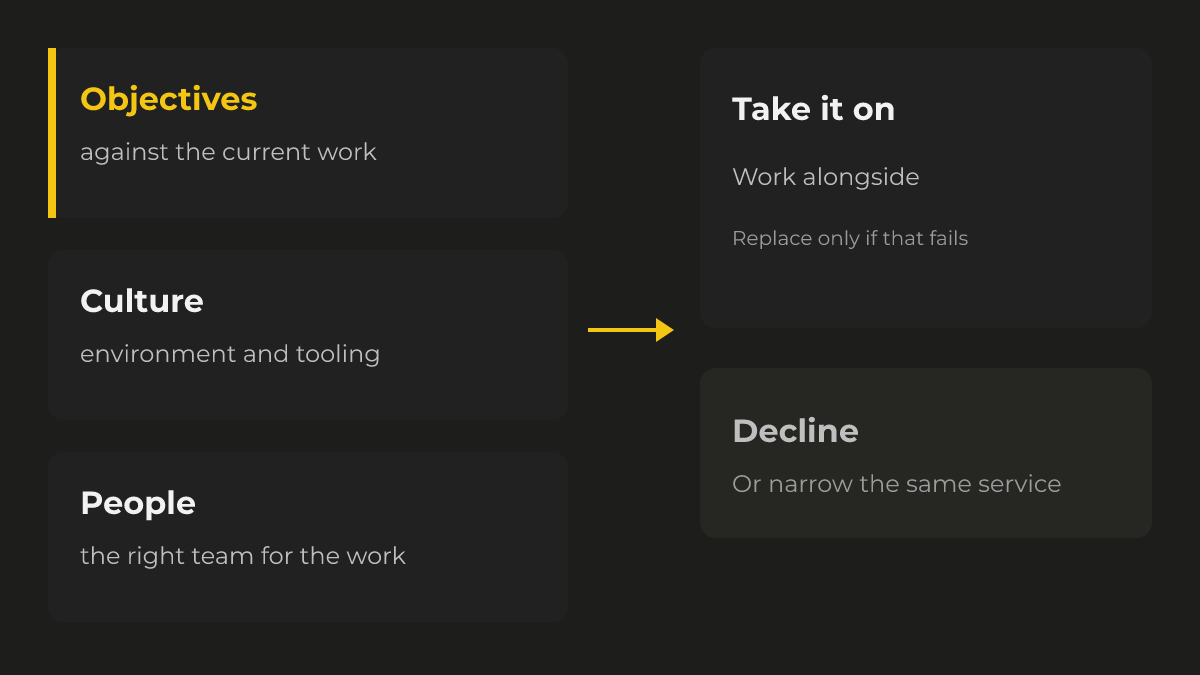
The first thing we assess is the company's objectives relative to its current work, culture and people. Is the company providing the right environment, tooling and culture for its project to thrive? Is the team staffed with the right people to make it happen? (Andy Slack, confirmed 15 November 2026.)
That question comes before a plan to stabilise the code, and before any decision to take the build on. It is not a checklist for a buyer or an investor. It asks whether the company around the project can support the work.
How to tell a people problem from a leadership problem is already on whether the development team is underperforming. This page does not repeat that.
Take it on only after the assessment
Whether to take a stuck project on is decided only after the assessment. Where the people are still there, the aim is to upskill and work alongside them. People are replaced with higher performers only when working alongside them is not possible (Andy Slack, confirmed 15 November 2026). How to judge the team itself stays on that page.
We have stepped into companies whose teams have stalled and whose throughput is not at the required level. One recent example is that there was a lack of technical leadership for some time, and the team was not being held accountable (Andy Slack, confirmed 15 November 2026). That is the situation we can describe. It names no company. It is not a rescue timeline, and it is not a result we promise.
No specific project we turned down is on file, so this page names none (Andy Slack, confirmed 15 November 2026).
If an agency or freelancer is still on it
The first access step is the same whether the agency or freelancer is still on the project or already holds the keys. Regain the repository and the hosting, in the company's name, not one person's (Andy Slack, confirmed 15 November 2026). The rest of those questions are on who owns my app code. This page does not repeat them.
After a takeover, the product is not ours
After a takeover, the product does not sit in our name (Andy Slack, confirmed 15 November 2026). The accounts you hold, and the questions to ask while someone else still has the keys, are already on who owns my app code. What you keep as the founder, so the product does not depend on one person, is on the page for an empty seat. This page adds the other dependency: a takeover of a stalled build must not make the product depend on us.
Book a founder fit call
If you want to talk a stalled build through, Book a founder fit call. That is the only call to action on this page. Other pieces are on the articles index.