
You paid an agency or freelancer to build your product. Now you want to leave, or you worry about what happens if they disappear. Start with two separate questions: who owns my app code, and who can actually access the systems that run it?
Copyright is a solicitor's question. Access is a practical check you can start without reading code. This page is about that check, for a nontechnical founder with a prototype, an MVP or a live product.
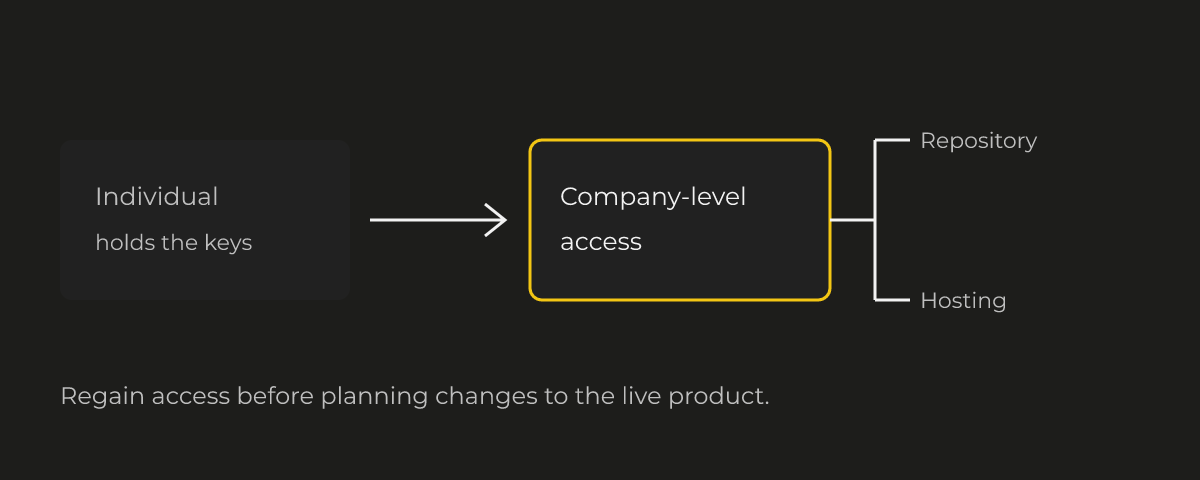
Regain access at company level, not through one person
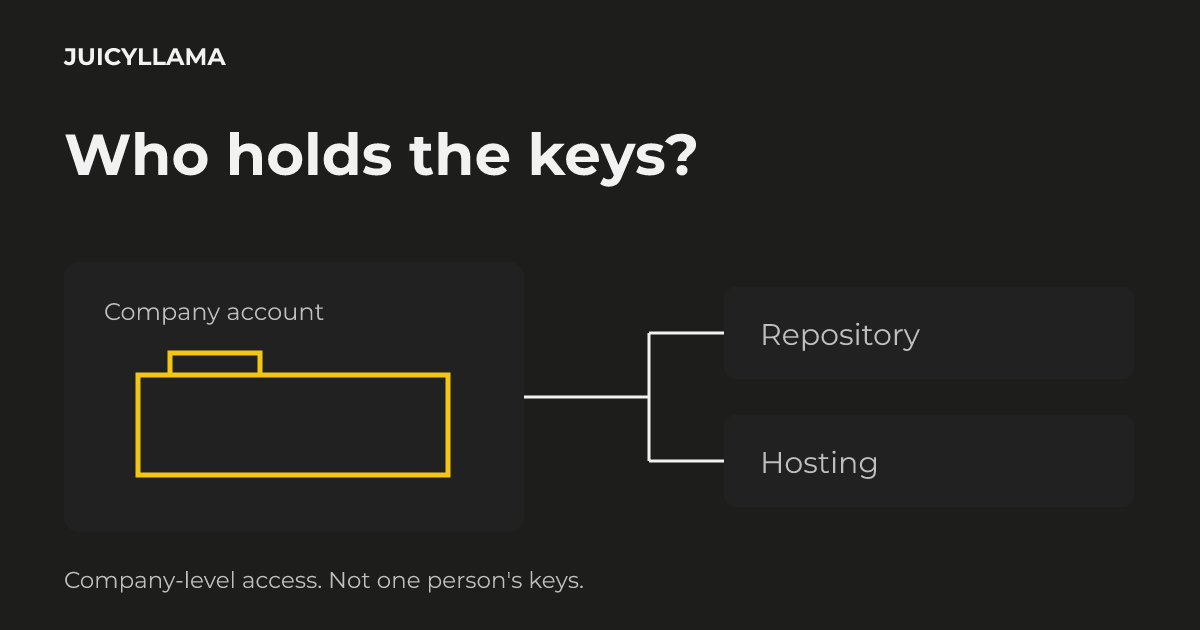
We have taken over products where a previous agency or freelancer held the keys. The most important part was regaining access to the hosting and the repository, with that access held at enterprise level rather than individual level (Andy Slack, confirmed 11 November 2026). The lesson is not to replace one person you depend on with another.
Ask to see where the source code is kept and where the product runs. Then ask whose company account holds each, and how your company can access it. An invitation for one person is not the answer to the whole question: establish where control sits before agreeing a switch.
A checklist to take to your current developer
Use these as questions, not instructions to change settings. Ask for answers you can keep with the product:
Source repository: where is the code, and can our company access it independently of you?
Hosting: which account runs the product, who controls it, and who pays the bill?
Domain and DNS: who controls the address and its settings, and what does each setting connect to?
Other accounts: where are error monitoring, product analytics and any AI tools, and who owns and pays for each?
Written record: where are the product decisions, roadmap and instructions, and can we read them ourselves?
Keep unanswered questions visible. If you are asking an agency to hand over code, do not let that request stand in for the separate questions about hosting and the other accounts. For an AI connection, the boundaries around what it reads and writes are covered in our AI integration checklist.
Do not change the settings yet
Our advice is not to change DNS, hosting or other settings until you fully understand how everything connects and have established that nothing will be lost or broken in the switch (Andy Slack, confirmed 11 November 2026). Getting access and changing the live product are separate steps.
Ask the person responsible for the proposed switch to explain those connections before making it. A copy of the code and a list of accounts are a starting point for that conversation, not a reason to start changing permissions or moving hosting immediately.
What this means on our service
On our fractional CTO and AI engineering team service, the client holds the repository, hosting, error monitoring, product analytics and AI tool accounts in their own name. They own and pay for the tools directly from the start, not on a handover day (Andy Slack, confirmed 11 November 2026). The current offer gives the ownership terms and tool examples. We are not making a separate promise here about domain or DNS ownership.
As confirmed by Andy Slack on 11 November 2026, the documented roadmap goes with the founder on exit; there is no release to request for the materials they already hold. The product record is written for the founder, not only engineers. Specs and tests are also readable in the founder's repository; our earlier product-build article covers that part. For this service's account ownership, use the current offer linked above.
For our work, copyright belongs to the client; copyright in external tooling stays with its owners (Andy Slack, confirmed 11 November 2026). That is our service position, not a ruling on your previous developer's agreement. Take that agreement to a solicitor rather than treating account access as proof of copyright ownership.
We assess an existing system before committing to take it over. The homepage explains that limit and the published price. If you lack trusted technical leadership and want to discuss your product, Book a founder fit call.