
Someone searching for a SaaS development company usually wants subscription software their own customers log into. A directory of agencies will not tell you whether a firm has built that, or only joined apps the business already uses. This page is how we tell the two apart, from products we are working on now and from SaaS work we have already published.
Products your customers log into
We are proactively working on products of that kind. Two examples are Zero Human and BUQ (Andy Slack, confirmed 5 November 2026). They are products, not a menu of services. Current automations and shared tasks are a different subject, covered in workflow automation software.
What the SaaS work included
On SaaS-sector work published with our client results, the list is no-code workflows, low-code API automation, a no-code client portal, business operations automation and CTO consultation (juicyllama.com, read 5 November 2026). The same kind of work has also been full bespoke development from the ground up (Andy Slack, confirmed 5 November 2026).
The results we will repeat from that sector are a client NPS of 8.7/10 and revenue growth of 240% in 2024 (same page). Those figures sit with the sector. They are not a claim that the next build will match them, and they are not a claim that the list of work caused the revenue.
When a workflow tool is not the product
A workflow tool between apps a client already uses is not enough when the system itself is the product, or when it has to carry large volumes of live data (Andy Slack, confirmed 5 November 2026). The rule, and the insurance example, are already in what to automate first, and when to build. This page does not retell them.
What you can change afterwards
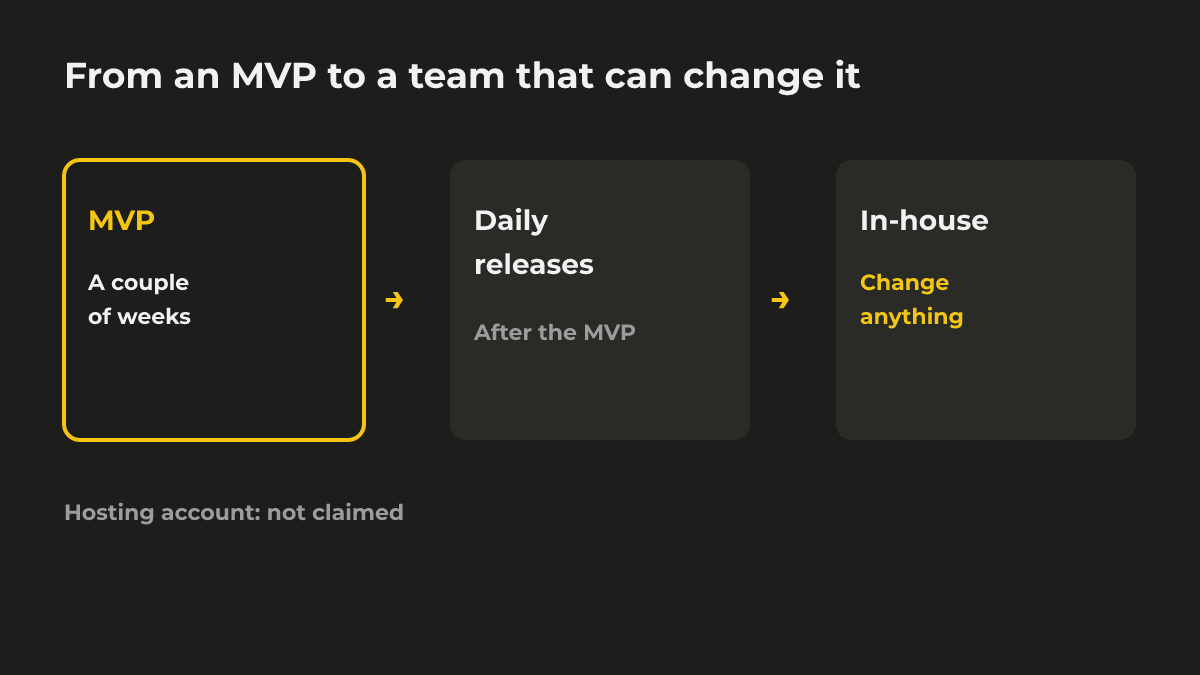
On a product build you get documentation, training, monitoring and operational visibility. You are trained to run the system, so you can change it, hire internally or move agency (Andy Slack, confirmed 5 November 2026). Where we use specs and tests, they stay in your repository. We do not say you own the hosting account. How a change is specified is in spec-driven development with AI coding agents. The wider service is bespoke development.
The stack we already use
When the system was the product, we used NestJS and Vue, with Nuxt and MySQL in the same family of work. That is the stack we already use. It was not chosen instead of one we preferred (Andy Slack, confirmed 5 November 2026). Bespoke development sets out the rest of the stack. AI-assisted development is how a team ships with that tooling.
The first slice
The first slice of a product build is an MVP, normally within a couple of weeks. After that, development continues and we release daily (Andy Slack, confirmed 5 November 2026).
Once your team takes it in-house
Once you bring the development in-house, you are free to change anything you want (Andy Slack, confirmed 5 November 2026). We do not keep a gate on those changes.
Constraints you should expect
There are always constraints to work around. They can be how specific data may be used, the technology, or the budget. There is always a solution (Andy Slack, confirmed 5 November 2026). That is a way of working, not a promise of revenue or of any other result.
If you want a product your customers log into, start with bespoke development or consulting. More of our writing is in the journal.