
Business process automation sounds bigger than the work it describes. This article is about the work: how we choose the first process to automate, where AI belongs in it, when a workflow tool is enough and when we write the software, and what a client gets at the end. The examples come from our client projects and from the automations we run on our own business.
What business process automation is
IBM defines business process automation (BPA) as “a strategy that uses software to automate complex and repetitive business processes” (IBM). Two neighbouring terms come up in the same conversations. Robotic process automation (RPA) automates routine tasks by mimicking how a person uses software. Business process management (BPM) is the wider discipline of modelling and improving processes, with BPA and RPA as tools inside it.
Wikipedia describes three ways to do it: writing software that connects the applications involved, using software robots that copy what a person does on screen, and adding AI and machine learning on top, which goes by names such as intelligent automation and hyperautomation (Wikipedia).
The choice we help clients make is narrower: a workflow tool that moves data between the systems you already use, or software written for the job. We come back to that choice below.
How we pick the first process
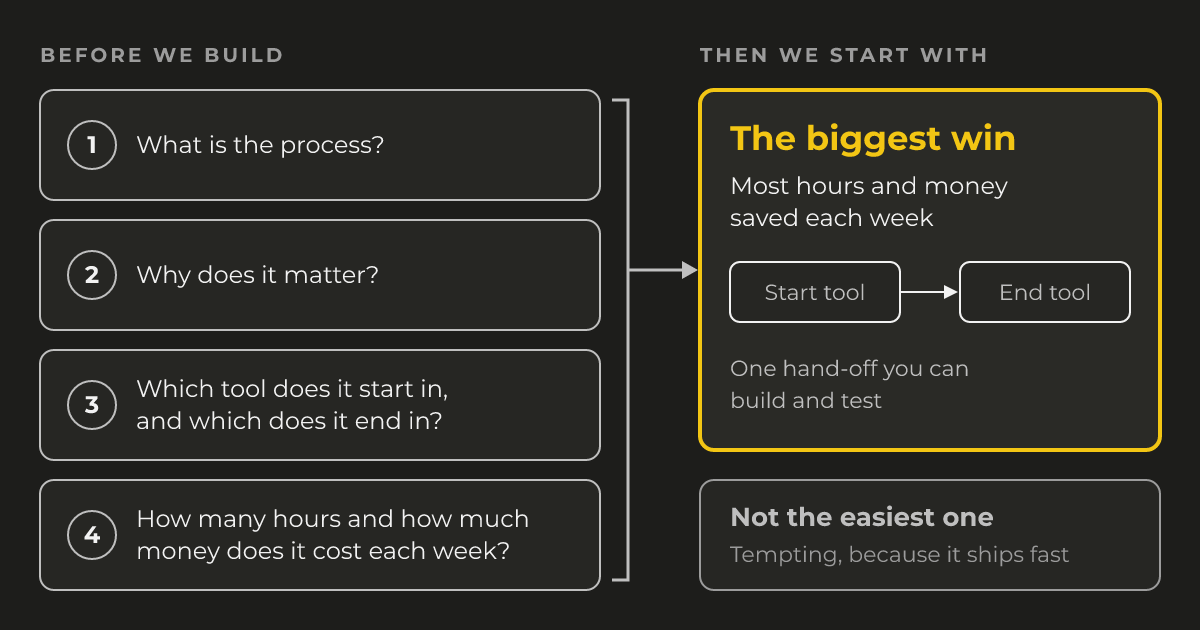
Before we build anything, we ask four things:
What is the process?
Why does it matter?
Which tool does it start in, and which does it end in?
How many hours and how much money does it cost each week?
Then we start with the biggest win, not the easiest one. Easy jobs are tempting because they ship fast, but the hours and money each week are what tell you whether an automation was worth building. Naming the start tool and the end tool matters too: it turns a wish like “automate our invoices” into a hand-off you can build and test.
For one client, the answers pointed at finance admin. Bills that need approval go to Slack with a one-click approve button, and AI completes draft bills from the attached invoice. We picked those jobs by how many hours each took a week, biggest win first.
For our own business, we automated triage of the company inbox. An agent labels new mail every 15 minutes and only escalates what needs the CEO.
Where AI belongs, and where plain rules do better
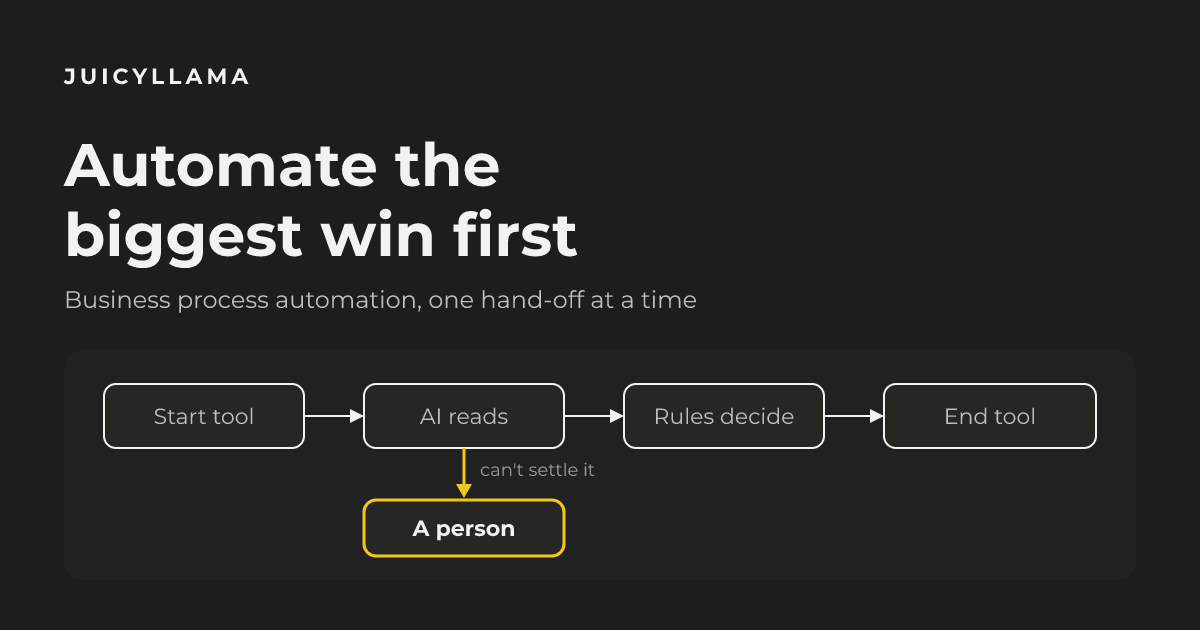
AI does the reading. In the finance work it pulls missing fields from an invoice PDF, and in our inbox it sorts new mail by sender and subject. Lookup tables and plain rules do the rest. Anything the AI can't settle goes to a person with the document attached, and no reply leaves without a person's approval.
That split is deliberate. Reading a messy document is where AI helps most. Once the facts are out of the document, what happens next is usually a rule someone in the business already knows, and a rule is easier to check than a guess.
Here is what didn't work. Our inbox agent stretched one decision too far: the CEO had chosen to leave one automated alert for engineering to pick up, and the agent applied that to every alert, so repeated crash notices were filed as FYI without being opened. If your automation learns from past decisions, check how far it carries them. A call about one alert is not a rule for all of them.
If the process you want to automate is software delivery itself, we wrote about that separately in The Agentic Development Loop.
Workflow tool or bespoke software
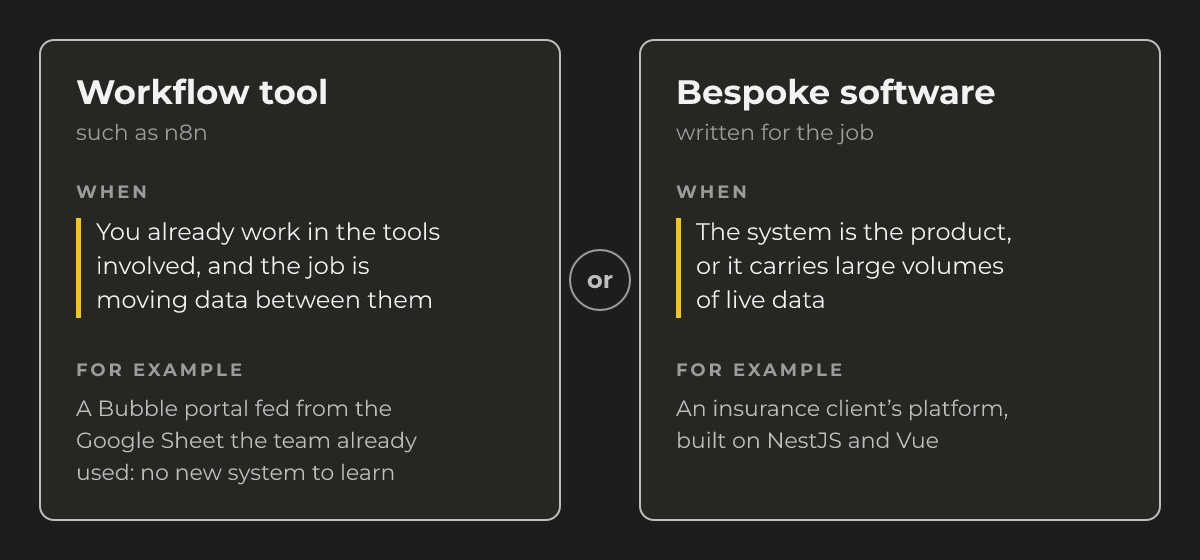
We build on a workflow tool such as n8n when the client already works in the tools involved and the job is moving data between them. One client's portal is a Bubble front end fed from the Google Sheet their team already used, so there was no new system to learn.
We write the software when the system is the product, or when it carries large volumes of live data. That was the call for an insurance client, whose platform we built on NestJS and Vue. When building is the right answer, it becomes the kind of project we describe under bespoke development.
Two examples, with the numbers we can share
For an ecommerce client, we built AI-powered customer service and automated the business's operations with no-code workflows: orders, affiliate tracking, and stock and sales reports. Average resolution time fell from 29.5 hours to 10.9 hours, and cNPS rose from 7.1 to 7.9.
For an insurance client, we built a real-time asset tracking portal and a data analytics portal that process over 1GB of flight data a day.
Both results are listed with our client results.
What you get at handover
Every automation is handed over with full training, so your own team can run and change it with no lock-in: you can hire internally or move agency at any time. Workflow builds come with a written summary of what was built and how it runs. Bespoke systems add documentation, monitoring and operational visibility.
An automation your team can't change is just a new dependency, so the handover is part of the build, not an extra.
How long a first automation takes
Our 17 workflow proposals from late 2024 quoted 4 to 24 hours of build, delivered 2 to 8 working days after payment. The smallest useful first slice is one hand-off between two tools: sending every new Shopify order to the affiliate platform was quoted at 4 hours.
That is the shape we suggest for a first project: one process, the four questions answered, and the smallest hand-off that saves real hours. Once it runs, the next process is easier to choose, because you know what the first one saved.
If you want a second view on which process to start with, our consulting covers AI and automation strategy, and our AI adoption work helps engineering teams fit AI into how they already deliver. There is more in our articles.