
If you are comparing MVP development services, start with what the first release should do, not how many features a package includes. At JuicyLlama, an MVP can be the first milestone of our fractional CTO service. It is not a separate fixed-duration build package.
The decisions below come from Andy Slack's answers for this article, confirmed on 11 November 2026. They describe how we scope a first release, not a promise that every product needs the same work.
One usable path, not the whole product
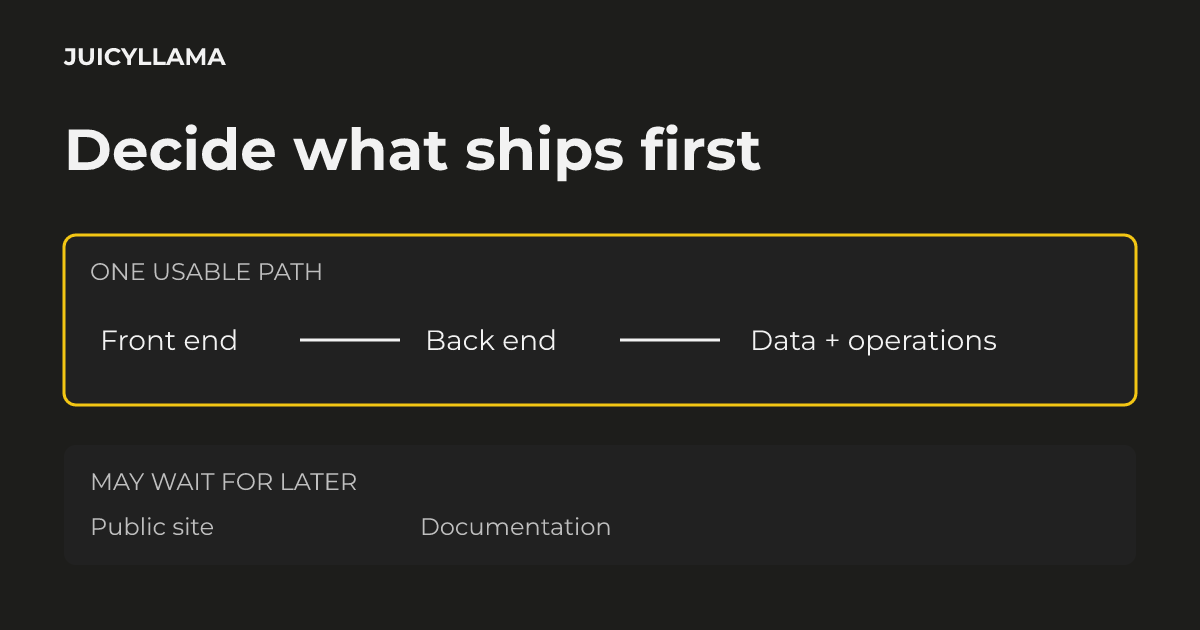
The first milestone is agreed during onboarding. It may be a prototype, a tightly scoped MVP, or taking over an existing system. For a build, we aim for a thin vertical: one usable path through the front end, back end, data and operations. The first release connects those parts rather than waiting for a big reveal.
Andy’s question for a founder to ask a provider is: “What is the most mission-critical feature that builds a moat from day one?” That is a question about which feature matters, not a guarantee that shipping it creates a defensible business.
What can stay out of the first release?
We may leave the public site or documentation out of a first release to favour internal testing and feature testing. That is a choice about the order of work: testing the feature can come before presenting it publicly. It is not a claim that a particular client skipped those things, or that every MVP should.
Leaving documentation out of that first slice does not remove it from the build. Documentation and training remain part of the work that lets your team run the system. The distinction is between what is ready for the first round of testing and what the team needs to operate it.
The tools follow the use case
We have our own tooling and preferences, which we normally lean towards unless a client has specific requirements or existing technology. We do not use a one-size-fits-all approach. The choice is the right tool for the specific use case, not a mandatory stack bundled with an MVP.
We also ask whether the team already works in the tools involved. Connecting a Google Sheet with another tool the team uses may avoid making them learn a new system. The wider decision is covered in when to use a workflow tool and when to build; this page does not repeat that comparison.
How long does it take, and what does it cost?
We do not put a number of weeks on an MVP. Our onboarding target is two to four weeks from receiving the access and inputs we need. That is an onboarding target, not an MVP delivery promise: we never promise an MVP in four weeks, whatever its size or complexity.
The public fractional CTO price is USD $9,999 setup and USD $2,999 a month, with no minimum term and 30 days’ notice to cancel. The fees exclude applicable taxes, AI usage, hosting and third-party tools. We quote the published US-dollar price rather than inventing a sterling conversion or a standalone MVP cost. Scope, acceptance criteria and a customised project budget are agreed before payment; the monthly fee starts after onboarding is accepted.
After the first release
We continue to develop, optimise and improve. AI-assisted delivery still works spec first, with tests and review rather than code written without a specification. Our spec-driven development article explains that process.
No vendor lock-in means nothing waits for a handover day. Your accounts and tools are yours from the start, and specs, agent instructions and tests go into your repository as the work happens. The build comes with documentation, monitoring, operational visibility and training. Acceptance checks that the accounts and access are yours and that the roadmap is written down.
To discuss an MVP as your first milestone, book a founder fit call. Bring the feature you think matters most, and what you are willing to leave out of the first release.