
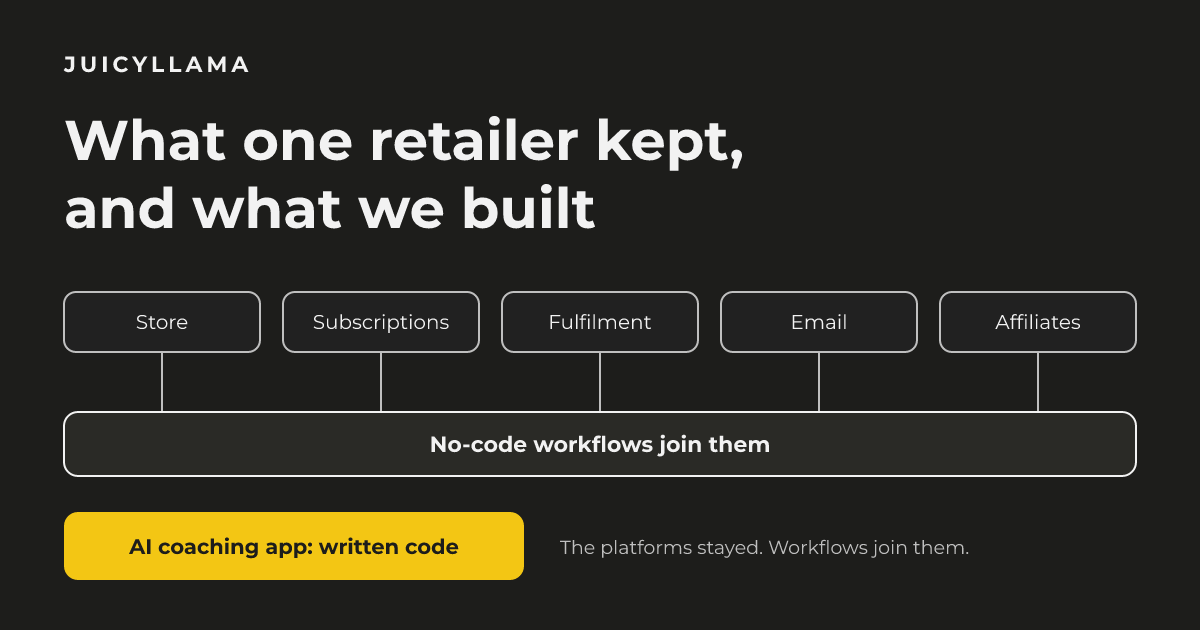
This page doesn't define ecommerce software development in the abstract. It shows one real system: an online retailer we worked for, which we don't name. It covers what the retailer kept on platforms it already ran, what we built between them, where the AI stops and a person decides, and what the retailer can change on its own. Everything about the retailer below comes from our project records (confirmed 9 November 2026).
The retailer, before
The retailer sells through its own Shopify store and on marketplaces, with subscriptions on Recharge and fulfilment through ShipBob. Before our work, its team put sales reports together by hand, and checked by hand that every sale reached its affiliate platform.
Restocking takes 60 days, so stock forecasting mattered.
What it kept, and what we built
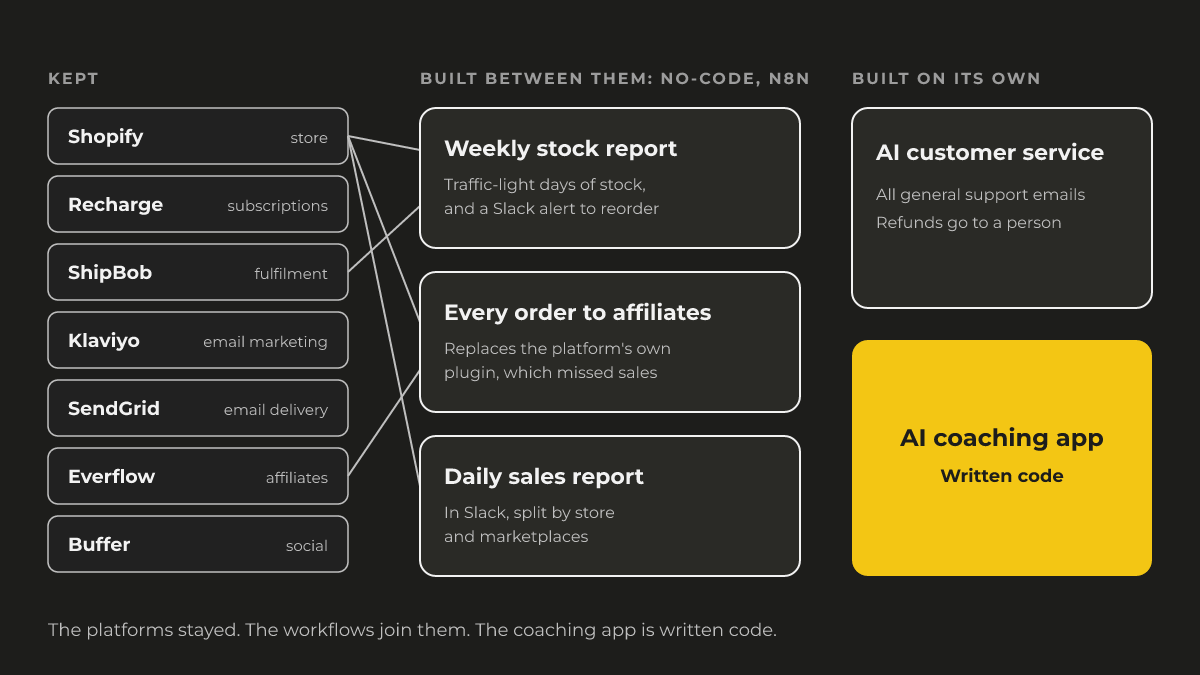
The retailer kept the platforms it already ran: Shopify, Recharge, ShipBob, Klaviyo and SendGrid, with Everflow for affiliates and Buffer for social. Here is what we built for it:
No-code workflows, built on n8n. Among them: a weekly stock report with a traffic-light days-of-stock status, and a Slack alert when a product needs reordering; every Shopify order sent to the affiliate platform; and a daily sales report in Slack, split by store and marketplaces.
AI-powered customer service. Where it stops is below.
A full-code AI coaching app. This is written code. The tools on record for this retailer include NestJS, Nuxt, Vue and AWS.
The workflows are no-code because the retailer's team already worked in those tools, and each job was moving data between them. Whether a job like that needs a connector, shared tasks or software written for it is in workflow automation software.
Build or buy: the first question we ask
When a retailer asks whether to build or buy, we ask the same question as on our other work: which tools does your team already work in? If the store, stock and email already run on tools they use, the first version joins those tools rather than replacing them. We write the software when the system is itself the product, or when it has to carry large volumes of live data.
That rule, with a different example, is in what to automate first, and when to build. When the system is a product your own customers log into, read a SaaS development company ships the product, not a directory.
Sometimes the answer is not to build at all. We have told a retailer not to build custom software when it had no technical resource in-house and adopting Shopify was easier for it. The signal was who would run it: with no technical resource in-house, a platform the retailer could adopt was the easier path.
The integrations this retailer asked for
For the one retailer in our records, reporting came up most: three of the seven workflows were stock and sales reports. Affiliate tracking came next, with two. That is one retailer's list, not a survey of retailers.
The longest quoted build turned each new blog post into posts and short videos for five social networks, at 24 hours of build.
What had gone wrong before we started was the affiliate platform's own Shopify plugin, which missed sales. We replaced it with a workflow that sends every order to the affiliate platform.
Where the AI stops and a person decides
The AI-powered customer service works on all general customer support emails. It escalates to a person for decisions that can't be reversed, such as refunds.
The line sits at what can't be undone: a refund can't be taken back, so a person makes that call. Before you agree an AI step with any partner, settle what it reads, what it writes and where a person approves. We set those questions out in AI integration services: what to agree before AI touches your systems.
The results, and what they don't say
For this retailer's work, average resolution time fell from 29.5 hours to 10.9 hours, and cNPS rose from 7.1 to 7.9. Both are listed with our client results. They are the results of the work as a whole, listed above. We don't claim which change caused them, or how long it took.
If the store needs software written
The first release is the first milestone we agree at onboarding: a prototype, a tightly scoped MVP, or taking over an existing system. It is built as one usable path through front end, back end, data and operations. Onboarding targets two to four weeks from when we receive access and inputs, and we never promise an MVP in four weeks. After the first release, we release daily.
We have no record of how soon a store's first slice reached shoppers, so we won't give you a number for it.
What the retailer keeps
The store, subscriptions, email and Slack run on the retailer's own accounts, and the workflows connect to them. Every solution comes with full training to self-administer, with no vendor lock-in: the retailer can hire internally or move agency at any time.
Before any ecommerce build starts, ask the partner, us included, to list what will run on your accounts and what your team will be trained to change.
If you run a store and want help with the build-or-buy call, we lead the technical decisions and an AI engineering team delivers them. Book a founder fit call, or read more in our articles.