
You need software built, and you are weighing up a dedicated software development team. Perhaps you have a prototype, an MVP or a live product, and nobody technical you trust to take it further. You want to know what a dedicated team is, whether it beats hiring in-house, using freelancers or briefing an agency, and who to hire it from.
Most guides on this are written by firms that supply development teams. When we looked at the top UK results for this search on 17 November 2026, none of the three we read in full put a technical leader in front of the team, and none said what you keep if you leave. This page is about those two gaps. Where it describes our own service, that is as confirmed with us on 18 November 2026.
What a dedicated development team is
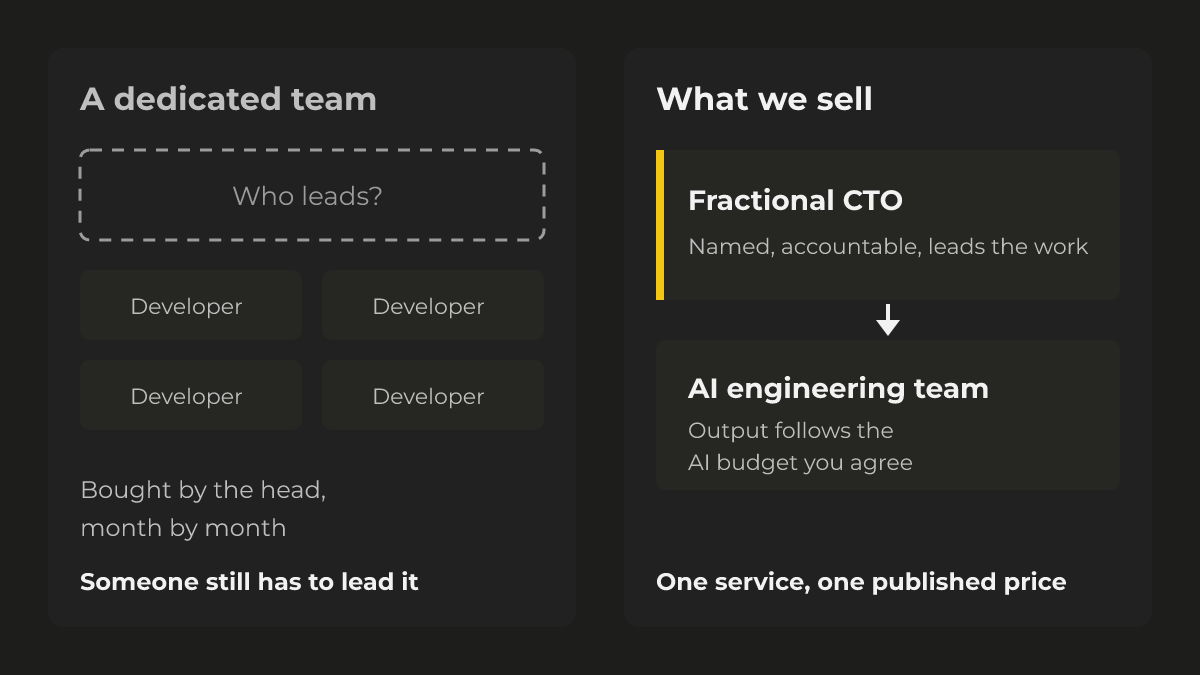
A dedicated development team is a group of developers who work on your product, and only your product, for a long stretch. An outside firm usually supplies them, and you pay for them month by month. Depending on the firm, you manage them yourself or the firm adds a project manager.
Two other phrases come up beside it. Staff augmentation means adding developers to your own team by the head. Offshore and nearshore teams mean hiring developers by location. Neither is what we do. We don't sell people by the month. We sell technical leadership and an AI engineering team as one service, at one published price.
The question every option leaves open
An in-house hire, freelancers, a project agency or a dedicated team: each gets you people who can write code. Each still leaves you with the same job. Someone has to decide what gets built and in what order, how it is built, and whether it is good enough to ship. If you are not technical, you cannot judge the last two from the code, and more developers will not judge them for you.
So before you compare day rates, ask who will lead the work. That one question changes the shortlist.
Three questions to ask any provider
Take these to any firm, us included. Next to each is what to listen for, and how it works on our service.
Who leads it technically, and who answers when it falls short?
Listen for a named person who makes the technical decisions and answers for delivery. A project manager who tracks tasks is useful, but that is not the same as someone who owns the architecture and answers for quality.
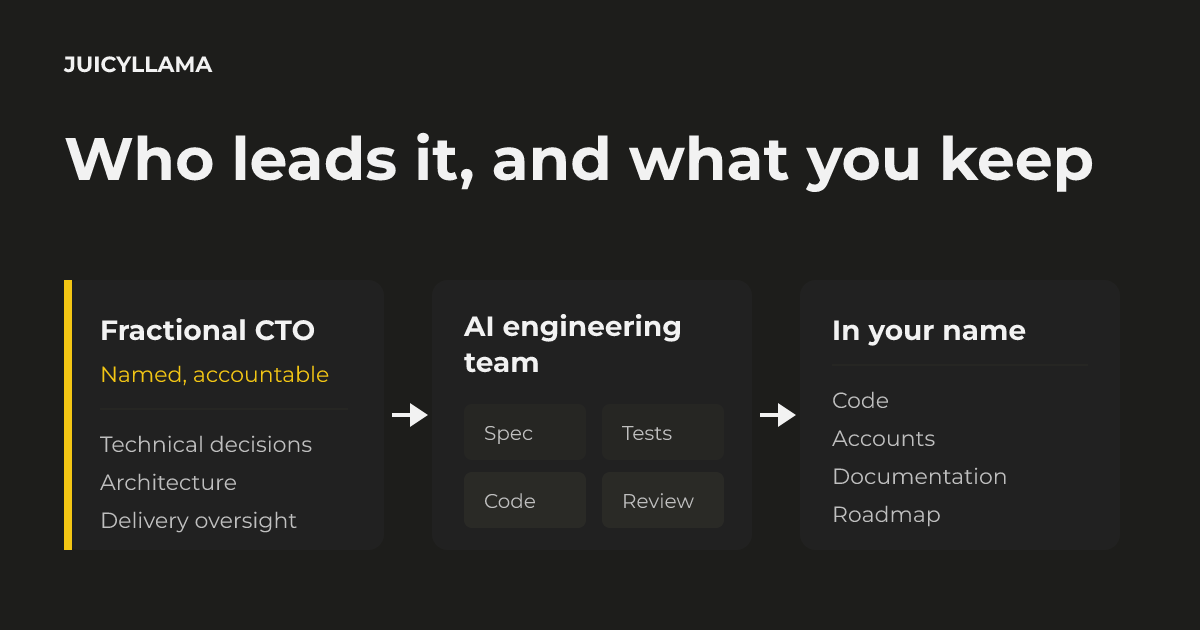
On our service, a named fractional CTO, backed by JuicyLlama founder oversight, is accountable for technical strategy, architecture, technical decisions and delivery oversight.
What will I see each week?
Listen for a fixed rhythm, and for a written record you can read without the provider in the room.
On our service, you have a weekly meeting with your fractional CTO, asynchronous support between meetings and active guidance on your product. Each change's decisions and reasons are written on its issue in your own repository, so you can read what was done and why. The questions worth asking in that meeting are in software development costs out of control.
What do I keep if I leave?
Listen for: everything, and it is already yours. If the code, the accounts or the documentation only come to you on a handover day, you depend on the provider until that day.
On our service, your code, accounts, documentation and engineering environment stay in your name from the start. You hold and pay for the repository, hosting, error monitoring, product analytics and AI tool accounts yourself. There is no minimum term: cancel with 30 days' notice and you take all of it with you, documented roadmap included, without asking us for a release. Every engagement comes with full training, so your team can run the product, hire in-house or move to another agency. What to check with a provider you already have is in who owns my app code.
What we sell instead of a dedicated team
We do not call ourselves a dedicated development team. We sell a fractional CTO who leads an AI engineering team set up for your product: one accountable partner for one product and one roadmap. We don't sell a fixed number of developers. Output follows the AI budget you agree, not a headcount or a number of features.
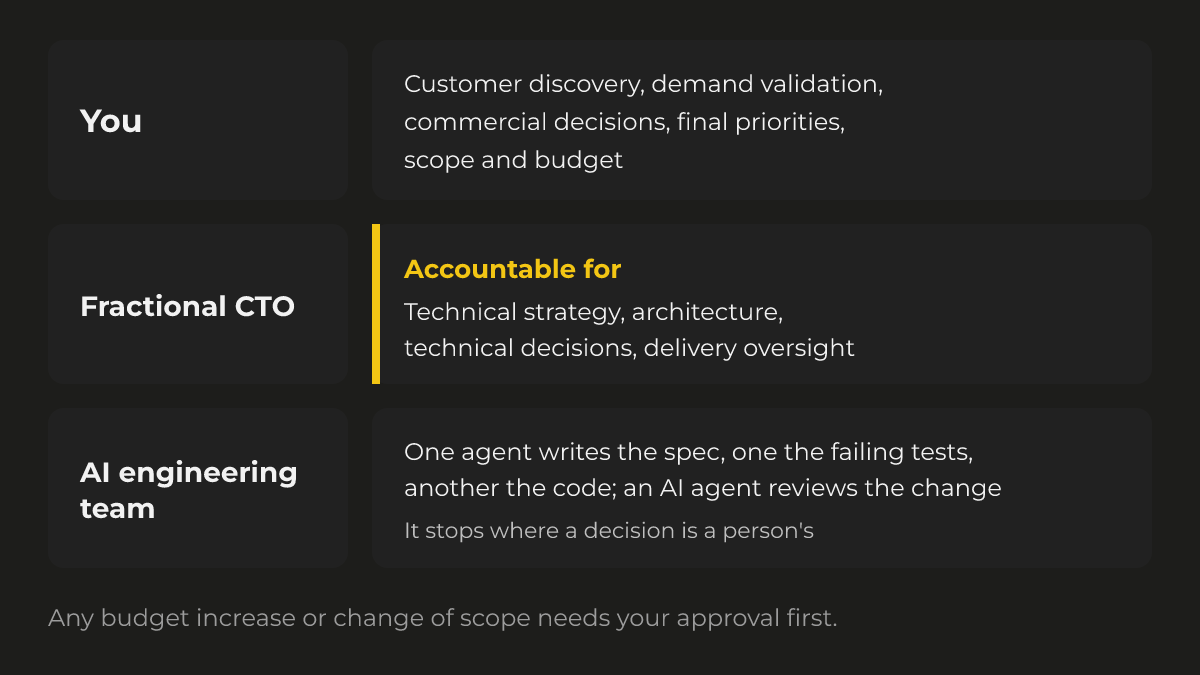
Most of the building is done by AI agents, not by hired developers. Each change starts as an issue with an outcome and acceptance criteria. One agent writes the spec, one writes failing tests, a separate one writes the code to pass them, and an AI code review agent reviews the change. Work stops where a decision belongs to a person, and your fractional CTO is accountable for what ships. How that runs day to day is in spec-driven development with AI coding agents and the agentic development loop.
Hiring any kind of team does not hand over the business decisions, and ours is no different. You still own customer discovery, demand validation, commercial decisions and final product priorities, plus scope and budget. Any budget increase or change of scope needs your approval first. Your fractional CTO makes the technical decisions, and the AI engineering team does the building.
When not to hire us
We're not the right fit if you already have trusted technical leadership and only want more developers, or if you want several products built at once: the service covers one product and one roadmap. If your current team is underperforming, more developers is usually the wrong fix, so assess first. Our view on that is in whether your development team is underperforming. When we're not a fit we say so and decline, or offer a tailored scope of the same service. We don't sell a different one.
How it starts
Onboarding aims for two to four weeks from when we have the access and inputs we need. It covers a technical assessment of your product, code and infrastructure, your environment and AI engineering team set up, a prioritised roadmap and an agreed first milestone. If you have an existing system, we assess it before we commit to take it over. What that assessment looks at is in technical due diligence for software. The monthly fee starts only when you accept onboarding against a written checklist.
The price is public: USD $9,999 setup and USD $2,999 a month, excluding taxes, AI usage, hosting and third-party tools. What each covers, and when you pay it, is on the homepage.
Book a founder fit call
If you are deciding how to get your product built and you lack trusted technical leadership, book a founder fit call. Tell us about the product, its stage and its technical situation today. Other pieces are on the articles index.