
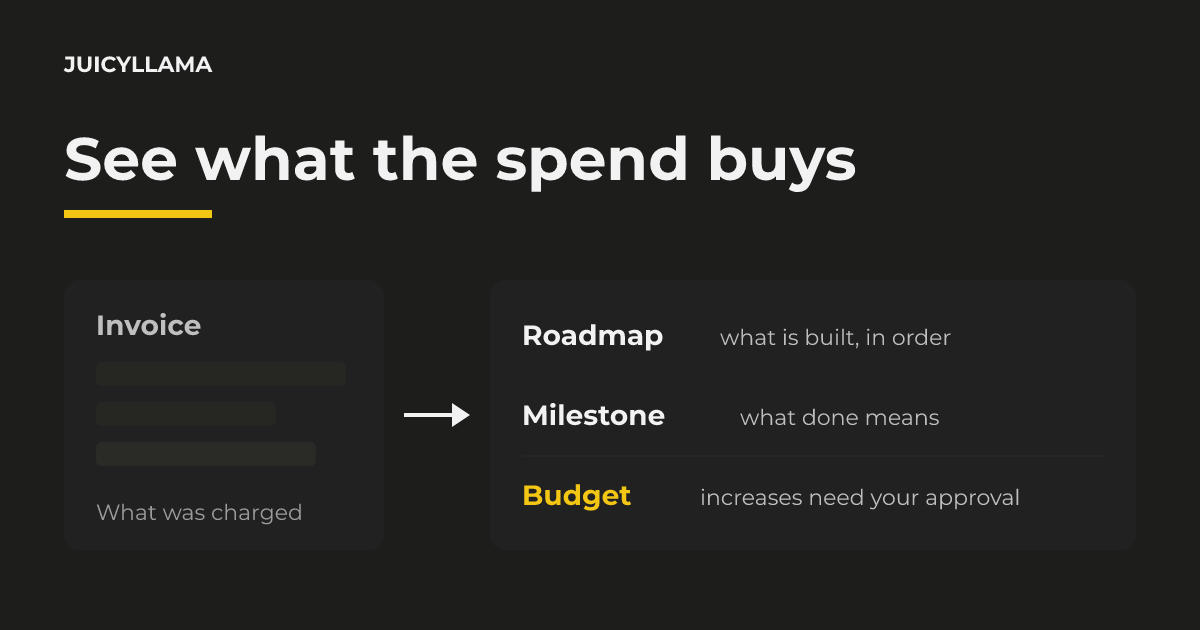
You are paying for development, and the invoices keep coming. What you cannot see is what they buy. There is no roadmap you can read, no clear sign of progress, and the estimate has moved again. You are not technical, so you cannot judge the work from the code. This page is for a nontechnical founder in that spot, with a prototype, an MVP or a live product.
Most advice on this subject is about how to spend less: cheaper suppliers, shorter lists of features. This page is about something else. It covers what you should be able to see, what may move when an estimate turns out wrong, and how to make sure spend cannot rise without your approval. Where it describes our own service, that is as confirmed with us on 16 November 2026.
An invoice is not a progress report
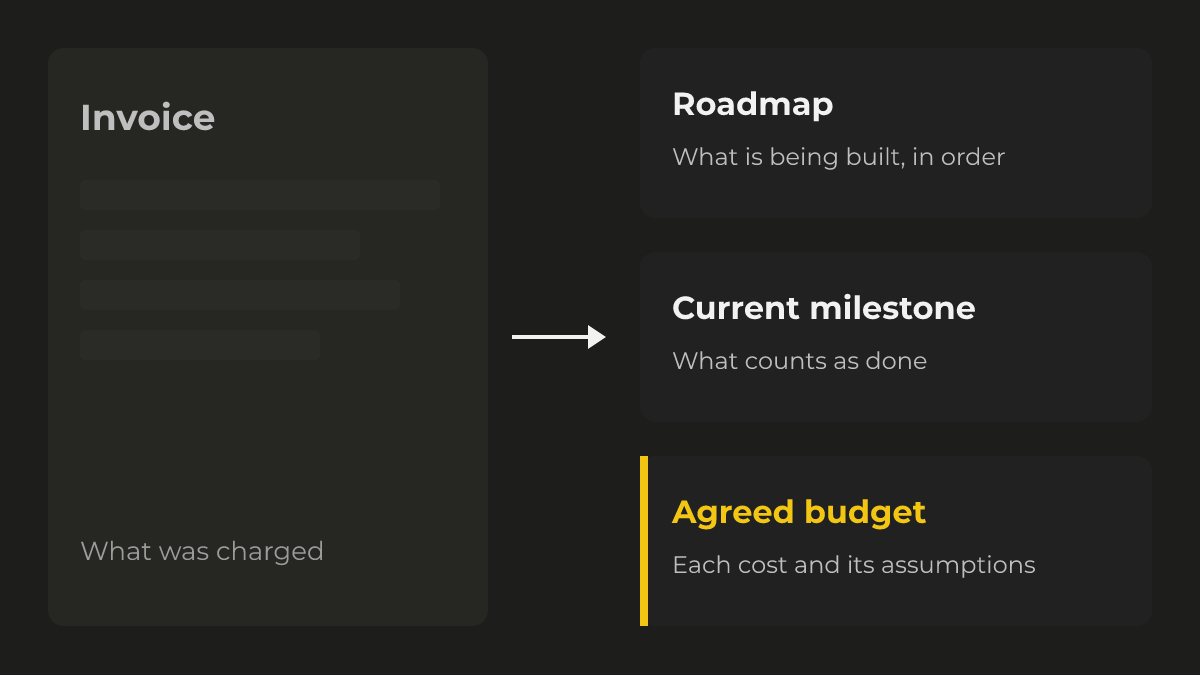
An invoice tells you what was charged. It does not tell you what moved. Before you decide whether the spend is too high, check that you can point to three things in writing:
The roadmap: the prioritised list of what is being built, in an order you agreed.
The current milestone: what is being worked on now, and what counts as done.
The budget you agreed: what it covers, and the assumptions it rests on.
If you cannot point to one of them, close that gap before you argue about cost. Without a roadmap, you cannot tell late work from extra work. Without the assumptions, you cannot tell why an estimate moved.
On our service, the roadmap and the first milestone are written during onboarding: a prioritised roadmap and an agreed first milestone. A documented roadmap is on the acceptance checklist, so it is in writing before the monthly fee begins. What you hold, and what to ask a current developer for, is on who owns my app code. What a first milestone should leave out is on MVP development services.
What to ask each week
Whoever builds your product, a few plain questions tell you more than a long status report. Ask them in the same order every week, and keep the answers:
Which item on the roadmap did this week's work move?
Is the current milestone where we agreed it would be? If not, what moved it?
What has been spent against the budget we agreed, and has any assumption behind it changed?
Is anything waiting for my decision: a change of scope, a change of priority, or more spend?
The last question matters most. A change that needs your decision should reach you as a question before it happens, not as a larger invoice after it.
On our service, there is a weekly meeting with your fractional CTO, asynchronous support between meetings, and active guidance on your product. This page does not set out an agenda for that meeting. The four questions are yours to take to any provider, us included.
When an estimate is wrong: what may move, and who approves
An estimate can be wrong. What matters is what is allowed to move when it is, and who has to say yes first. On our service, after onboarding, it works like this:
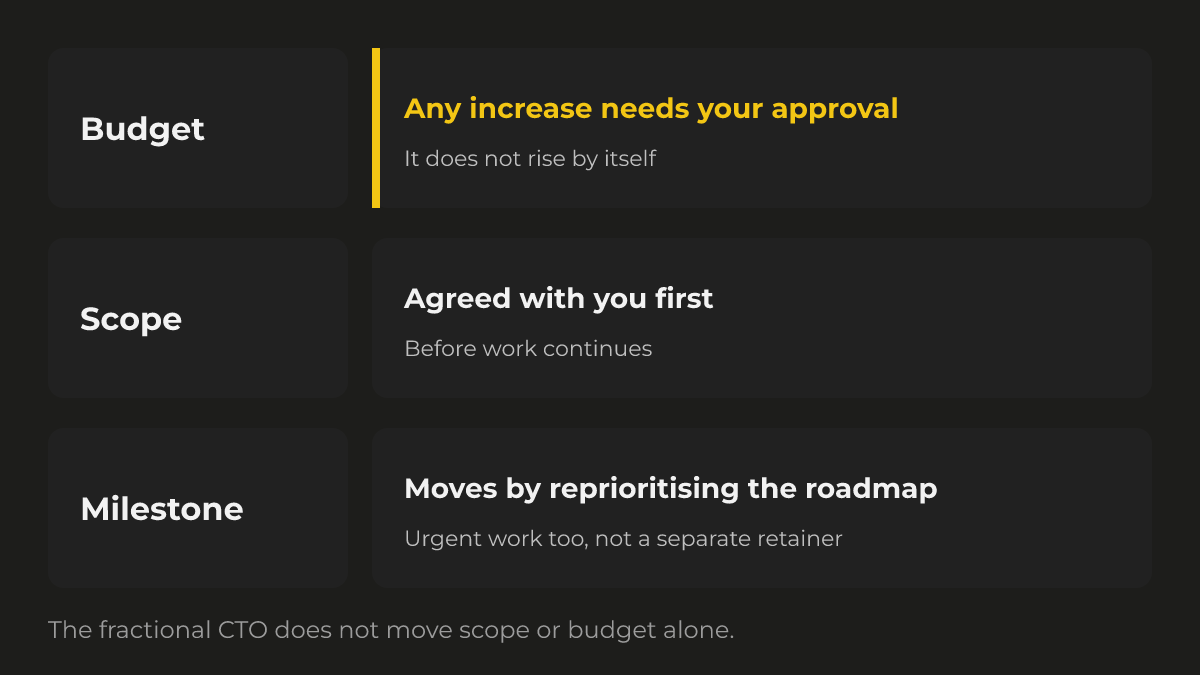
The budget does not rise by itself. A wrong estimate is not a reason for spend to go up on its own. Any increase to the budget needs your approval.
The scope changes only by agreement. A change of scope is agreed with you before work continues.
The milestone can move. It moves by reprioritising the roadmap. Urgent work is handled the same way, not by a separate retainer.
You approve scope and budget. The fractional CTO does not move either one alone.
Onboarding has its own rule for an overrun, set out on the homepage. That rule is for onboarding only. It does not extend to later milestones: later work stays inside the agreed scope and budget unless you approve a change.
Budget controls that stop spend rising on its own
A budget only controls spend if it says what would make it change. Before you commit to any provider, ask for the budget in writing, with the assumptions behind each cost. When an estimate moves later, the written assumptions show you which one changed.
On our service, some parts of the project budget are always there, and some depend on the project:
Always there: our fees, each recurring or usage cost, the assumptions behind them, and the controls. Any increase needs your approval, and nothing increases automatically.
Depends on the project: which tools it uses. You own your tools and pay for them directly. Zero Human, Railway, Sentry and PostHog are examples, and not every project needs every tool.
We do not publish a sample budget, because the lines depend on your product. Additional human specialist work also needs your approval before it starts. The published price, and what it leaves out, are on the homepage.
If AI agents do part of the work, their usage is spend too. Who approves more of it belongs in the same conversation as quality and access, as we set out in how to adopt AI in software development.
Which calls are yours
Seeing the spend only helps if you know which decisions are yours. On our service, the calls that change spend are yours: final product priorities, scope and budget, including any budget increase and any extra specialist work. Customer discovery, demand and commercial decisions stay with you too.
The fractional CTO decides technical strategy, architecture, technical decisions and delivery oversight, and is accountable for them. So when you talk about spend each week, you are talking about your own decisions: whether to change a priority, agree a change of scope, or approve more spend. You do not need to read the code to make those calls.
Book a founder fit call
We sell one service: a fractional CTO who leads an AI engineering team. If it is not a fit for you, we say so and decline, or offer a tailored scope of the same service. We do not sell a different service. If you want to talk through what you are paying for now, and what you should be able to see, book a founder fit call. Other pieces are on the articles index.